

The Dutch Start-UP Fruitleather: Made A Vegan Leather Scrap Mango
Apr 14, 2022
As the European mango trading center, the Netherlands imports more than half of the total amount of mangoes in Europe every year. However, due to logistics or storage environment and other reasons, many damaged and rotten mangoes are directly discarded, resulting in waste and a certain negative impact on the environment.
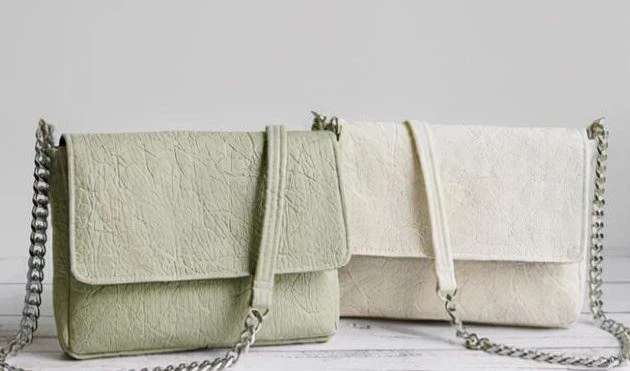
Fruitleather, a Dutch startup founded in 2015, has come up with a new way to solve this problem: recycle these discarded mangoes into "vegan leather."
Turn waste into treasure:
Turn discarded mangoes into vegan leather
Fruitleather was co-founded by Hugo De Boon and Koen Meerkerk, two university classmates who both studied interior design at Willem de Kooning Academy in Rotterdam, The Netherlands. At university, Hugo de Boon and Koen Meerkerk were very interested in discussing the circular economy and how to create value from things that people defined as "useless".
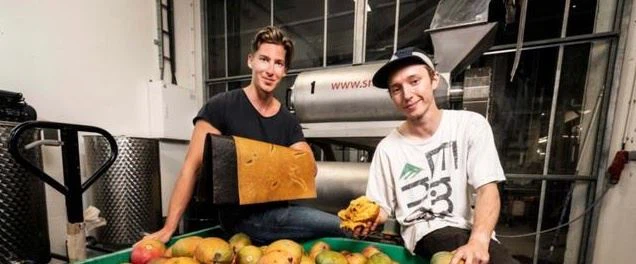
Above from left to right: Koen Meerkerk and Hugo de Boon
They note that the FOOD and Agriculture Organization of the United Nations (FAO) estimates that waste food around the world weighs 1.3 billion tons each year, equivalent to a third of all food production. About 45 percent of the fruit that farmers produce for consumption ends up being thrown away, and at that rate about 30 percent of the agricultural land on earth is used to produce the fruit that ends up being thrown away. In addition to the waste of land resources, waste fruit will also cause a series of environmental problems. According to statistics, in some developed countries, 10% of the greenhouse gas is emitted in the production of these eventually discarded fruits.
They also learned that in the fashion industry, the use of animal leather also caused great negative impact to the environment, ethical treatment of animals (PETA) is a set of data show that each year more than 1 billion animals were killed, to get their fur, the fur in the process of be cleaned and made into leather produced about 650 million kg of carbon dioxide.
So Hugo de Boon and Koen Meerkerk, who have a background in design, set out to wonder if waste food could be turned into treasure. With this idea, the couple moved in Rotterdam business incubators -- Bluecity, circular economy started his test here, after many experiments, they think that made out of mango leather softness and toughness are good, and as Europe's biggest mango trading countries, the Netherlands mango waste huge every year, so, They decided that Fruitleather's first product would be vegan leather made from mango.
Fruitleather has a long-term partnership with Total Exotics, a Dutch mango importer. The company imports 6 million kilograms of mangoes a year, but about 1,500 are thrown away every week during quality control.
"I used to wonder if there was a new way to recycle these mangoes so they wouldn't get thrown away," says Anneke Bouman, Manager of Quality assurance and sustainability at Total Exotics. "Fruitleather is the best option."
Fruitleather now costs between 49.99 and 60 euros per mango, depending on the size of the leather, from 49.99 euros for a 56 x 38 cm leather to 60 euros for a 60 x 40 cm leather.
Fruitleather's goal is not to compete with the traditional leather industry, de Boon says. "We started Fruitleather not to completely replace traditional leather, but to provide an alternative to the industry."